Operate
Secrets
The plane can vend run-bound connector sessions. It should not become a second vault UI. Pattern: secrets in your store → env / files / Vault → ${VAR} or secret_ref in config.
What it is
Config and connector YAML support ${ENV} substitution at load. Connectors can also use
auth.secret_ref so the credential is resolved at GetSession time (env, file mount, or HashiCorp Vault KV v2 / v1).
Helm charts mount Secrets into env or files. Runners receive short-lived session material — not long-lived third-party tokens in agent env forever.
Why it is here
Enterprise reviews ask “where do API keys live?” Answer: your secret manager; Runkite references them. Admin does not CRUD secrets.
How to implement
- Keep raw tokens in Vault / cloud SM / sealed K8s Secrets — never commit them.
- Mount or inject as env vars / files into the control plane (and runners only if unavoidable).
- Reference with
${NAME}inlanggraph.json/ connector YAML, or setauth.secret_ref(do not set both for the same field). - Prefer connectors for outbound SaaS calls so grants, HITL, and audit apply.
- Rotate by updating the secret + rolling pods; revoke old Admin/client keys in config.
${ENV} at load
# connector snippet — expanded when the registry loads
auth:
  type: bearer
  bearer_token: ${GITHUB_TOKEN}
secret_ref at GetSession
Use when you want the plane to fetch the credential only when minting a session (not bake it into the in-memory config at startup).
Schemes: env:VAR, file:/path, vault:secret/data/runkite/…#field.
Supported auth types: api_key, bearer, oauth2_client_credentials, oauth2_token_exchange (fills client_secret).
The ref string itself is not ${ENV}-expanded.
auth:
  type: api_key
  secret_ref: vault:secret/data/runkite/connectors/github#token
# or: secret_ref: file:/var/run/secrets/github_token
# or: secret_ref: env:GITHUB_TOKEN
Vault env on the control plane
| Var | Role |
|---|---|
VAULT_ADDR | Vault base URL (required for vault:) |
VAULT_TOKEN or VAULT_TOKEN_FILE | Token; prefer Agent-injected file |
VAULT_NAMESPACE | Optional Enterprise namespace header |
VAULT_ALLOWED_PREFIX | Default secret/data/runkite/; paths outside fail closed |
KV v2 paths include the /data/ segment Vault expects on the HTTP API (default allowlist secret/data/runkite/). KV v1 paths omit /data/ — set VAULT_ALLOWED_PREFIX accordingly (e.g. secret/runkite/). Paths are cleaned before the prefix check; .. is rejected.
Kubernetes / OpenShift patterns
- Secret → env —
envFrom/valueFrom.secretKeyRef, then${VAR}orsecret_ref: env:VAR. - Secret → file — volume mount (or projected service account token beside it);
secret_ref: file:/var/run/secrets/…. - Vault Agent Injector — annotate the CP pod; Agent writes a token file + optional rendered secrets; set
VAULT_TOKEN_FILEand/orfile:refs. Runkite does not run Vault CSI itself. - OpenShift — same as K8s Secrets / projected volumes; keep long-lived IdP secrets out of the runner Deployment.
In the product
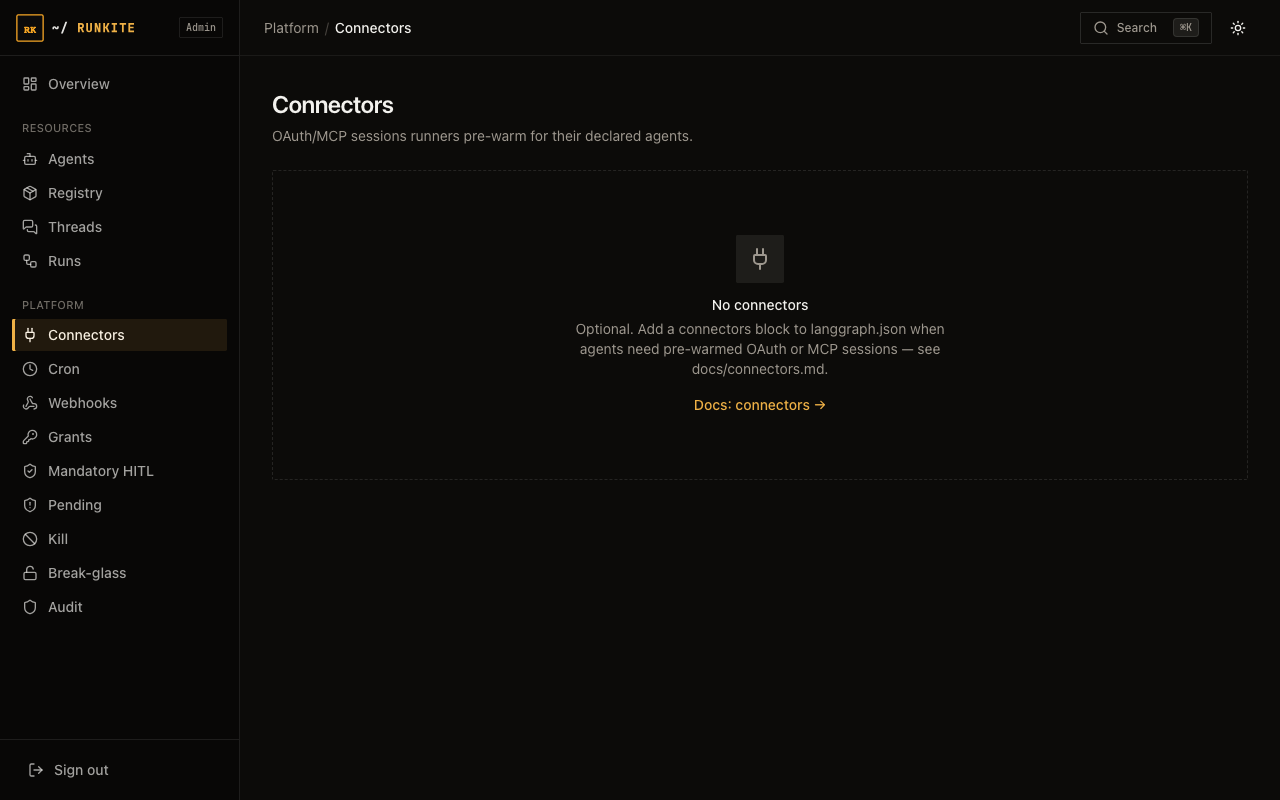
What to expect
- Missing env —
${VAR}substitution fails closed at load;env:refs fail at GetSession if unset. - Not in Redis — do not park long-lived third-party tokens in the queue payload.
- Next — credentials map, connectors, production day-0.