Build
Registry
A tenant-scoped catalog of agent definitions: publish, search, version history. Metadata + source_ref — not auto-deploy.
What it is
Entries carry display name, tags, author, and a source_ref (git URL, plain URL, or inline config snippet).
Version bumps write immutable snapshots when content changes.
Why it is here
Teams need a discoverable list of agents without turning the plane into a package manager that fetches and runs arbitrary code.
How to implement
Two equivalent paths — pick whichever fits your workflow. Both write to the same table, so an entry published one way shows up immediately when you look it up the other.
From your CI/CD or a script — the client-facing API, scoped by your own auth context:
PUT /registry/entries/{name}with metadata +source_type/source_ref.POST /registry/searchby name substring, tags (all must match), or author.- Browse history via
GET /registry/entries/{name}/versions. - Wire the source into a runner config yourself — publishing does not register a live agent.
PUT /registry/entries/sales-qualifier
{
  "display_name": "Sales Qualifier",
  "description": "Qualifies inbound leads",
  "author": "alice",
  "tags": ["sales", "lead-gen"],
  "source_type": "git",
  "source_ref": "https://github.com/example/sales-qualifier@main"
}
From Admin, by hand — no request body to write yourself:
- Open
/admin/registryand click Publish entry for a new one, or click any row to open an existing entry. - Fill in the same fields as the API body above through a plain form — tenant, name (slug), display name, tags, and
source_type/source_ref. - Save changes updates the entry in place (a real content change still writes a new version, exactly like the API path); Delete removes it and its version history.
- The same "publishing is not deploying" rule applies here too — the entry is discoverable metadata, not a live agent, regardless of which path you used to create it.
Admin writes go through PUT / DELETE /admin-api/registry/{name} (an Admin-only route, distinct from the client-facing /registry/entries/{name} above) and are audited the same way every other Admin mutation is.
In the product
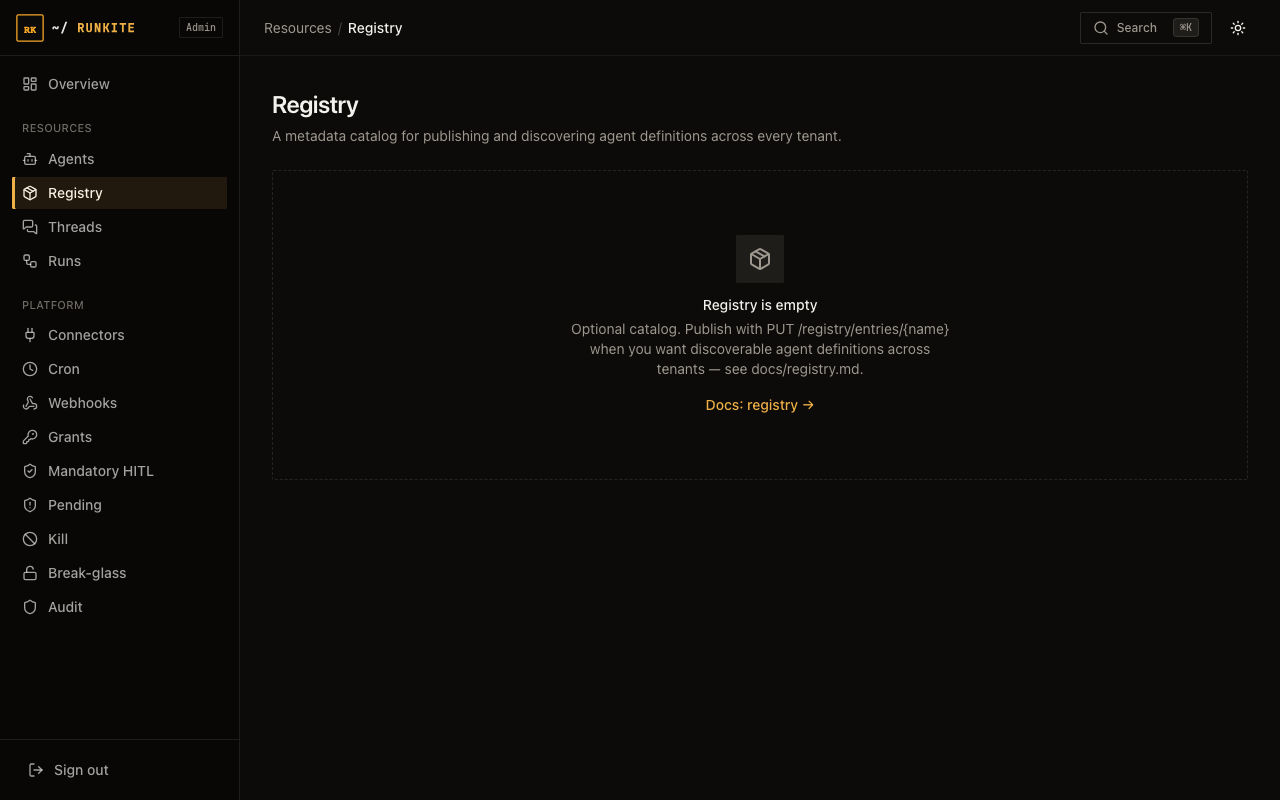
What to expect
- Tenant-private — not a cross-tenant public marketplace.
- No review queue — publish is immediately visible in-tenant.
- Admin name collisions — use
?tenant_id=when two tenants share a name.
Reference: docs/registry.md · Agents